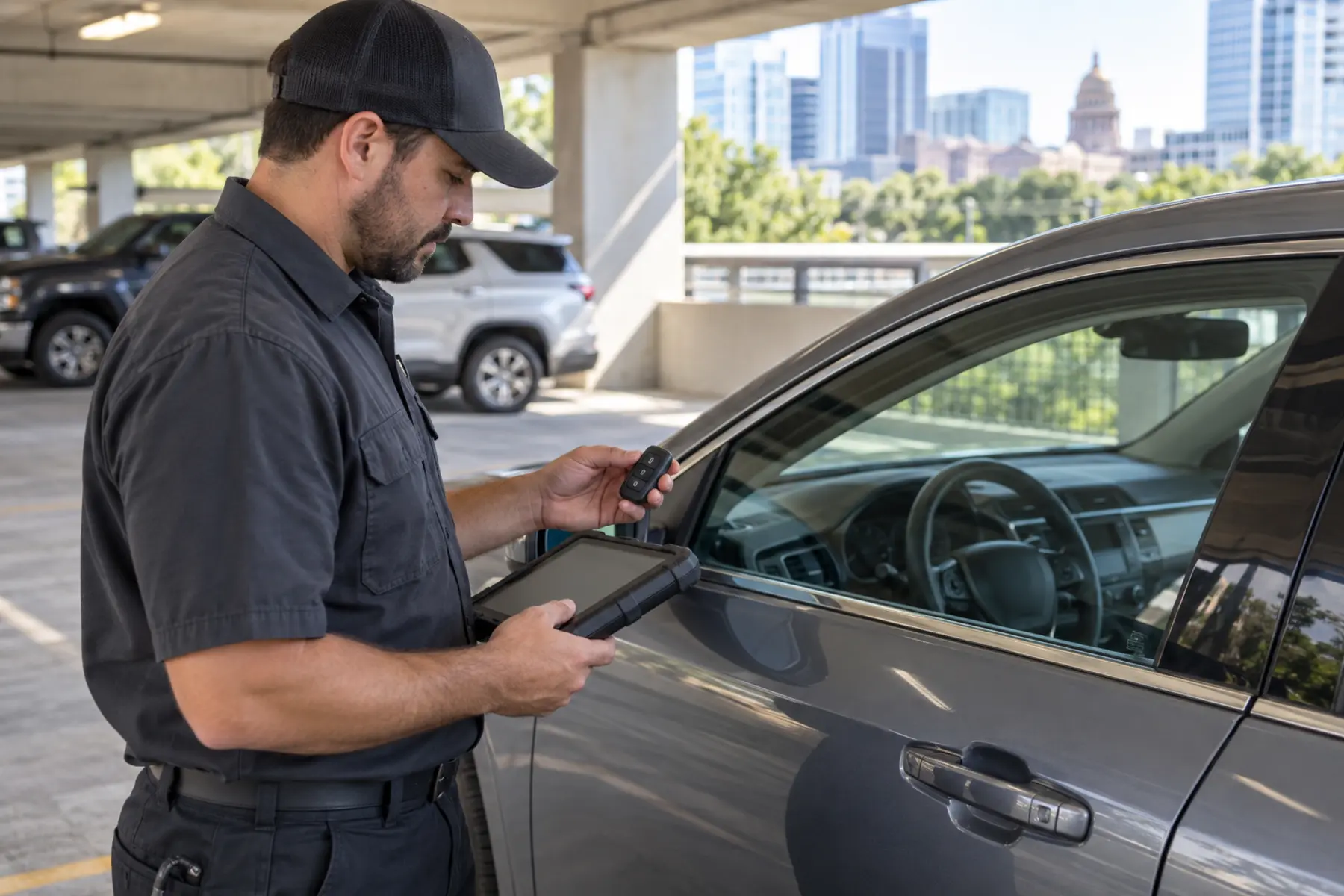
At a glance
What this service can cover.
- Car and truck lockout help
- Lost-key and spare-key assessment
- Transponder and supported smart-key work
- Key fob testing and programming
Start with the vehicle.
Year, make, model, and key style are the useful starting points. Two vehicles that look nearly identical can use different chips, blades, programming procedures, or security systems. A photo of the existing key or dashboard message can help when one is available.
Also tell us whether any working key remains. Adding a spare while one key still works is often a different process from creating a key when every copy is gone. That small detail can change the equipment and preparation for the visit.
Lockout or lost key?
If the key is visible inside the vehicle, the immediate goal is access. If the only key is missing, opening the door may be just the first step. You may also need a new key cut and electronically paired before the vehicle can be driven.
Do not assume a remote that unlocks the doors can also start the car. Remote buttons, a transponder, and proximity authorization can be separate parts of the same device. Describe exactly what still works.
Meet at the exact vehicle.
Large apartment communities, office campuses, The Domain garages, and shopping-center lots can share one street address. Include the building, garage level, row, color, and a nearby fixed landmark. A clear meeting point saves circling and phone calls.
Choose a safe location away from moving traffic. If the vehicle is on a highway shoulder or in a hazardous position, contact the appropriate roadside or emergency service first. Locksmith work should not begin in an unsafe lane.
Check used fobs and online blanks.
A bargain key online is not automatically programmable to your vehicle. The frequency, chip family, button layout, part number, and prior programming history can matter. Some used smart keys cannot be reused as simply as a seller suggests.
Send the listing or part number before the appointment when possible. We would rather identify a likely mismatch early than discover it beside the car after time has been spent traveling.
Test every included function.
A completed key job should be checked against the agreed scope. That may include mechanical door access, remote lock and unlock, trunk release, panic button, proximity recognition, and starting the vehicle. Not every key includes every function.
Keep the working key away from the car while the new one is tested so an old fob does not accidentally make the result look successful. That simple check gives a cleaner answer.
A closer look
A clearer call from the parking spot
Stand where you can see the vehicle safely and read the dashboard message if there is one. Do not keep pressing a cracked fob, forcing a key in the ignition, or pulling on a door handle that feels loose. The exact symptom should arrive intact with the service request.
Photograph both sides of any remaining key or fob without including personal documents. If no key remains, find the VIN through the windshield or in your paperwork, but do not post it publicly. The dispatcher can explain which details are needed for support and verification.
Ask whether the expected work includes only entry, a mechanical key, electronic programming, or every function of a complete remote. A low quote for one step can sound like the price for the entire result when the scope is not stated.
Before the technician leaves, sit in the driver seat and try the new key yourself. Lock and unlock, start the vehicle, and test the functions included in the job. A customer should not discover the missing step at the next stop.
Start with the condition now.
For auto locksmith, describe what still works as carefully as what failed. Mention whether the problem is constant or intermittent, whether another key or entrance works, and whether anything changed just before it began. Those details can affect the tools, parts, time, and even the type of provider the job needs.
Ask what the proposed work is meant to accomplish and what will remain unchanged. Entry restores access. Rekeying changes which key operates a compatible cylinder. Repair addresses a performance problem. Replacement changes hardware. Vehicle programming may cover some key functions without creating every remote feature. The right label should follow the desired result.
Before the technician leaves, test that result in normal conditions. Close the door, remove frame pressure, move other vehicle keys away, or try the old key after a rekey. A realistic final test is more valuable than a demonstration designed only to work once.
Three useful questions
Before you book.
Can an automotive locksmith make a key with no original?
Often, for supported vehicles. The year, make, model, key system, and proof of ownership determine what is possible.
Do you work on motorcycles?
No. Motorcycle key and ignition work is outside the services described on this site.
Can you unlock a car without damaging it?
The method depends on the vehicle. The goal is controlled entry using an approach appropriate for the model and condition.